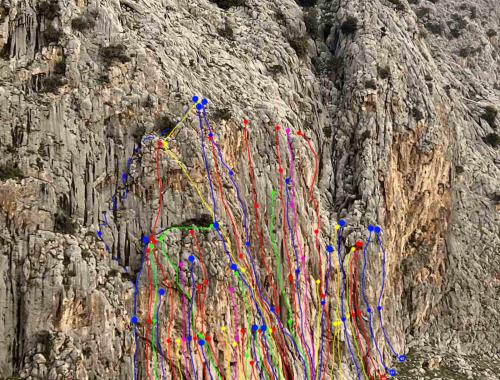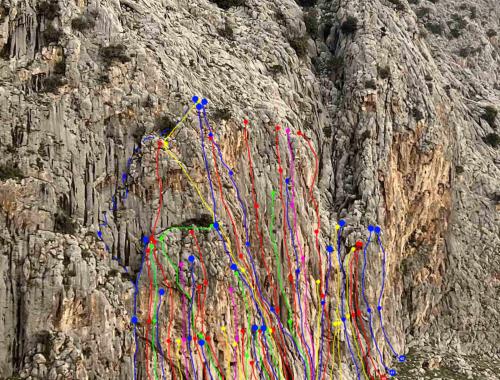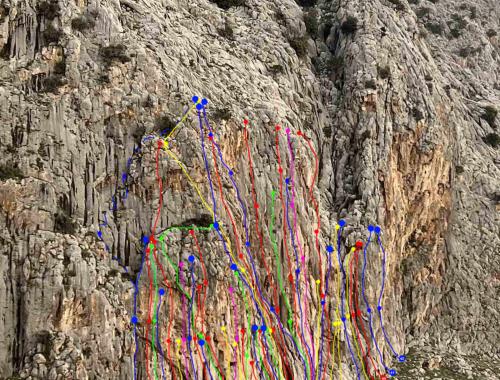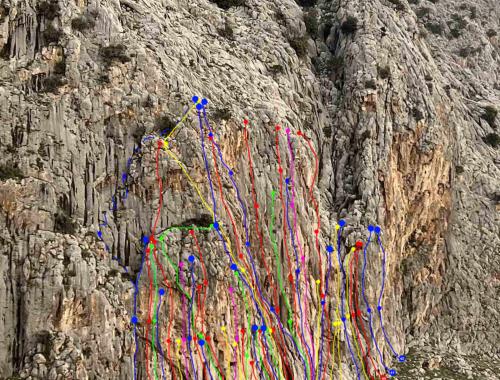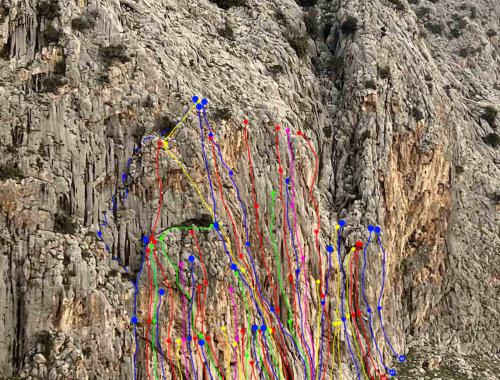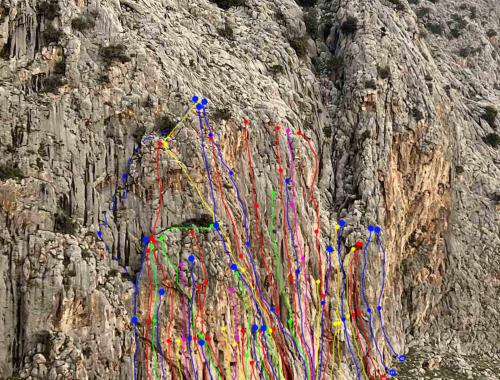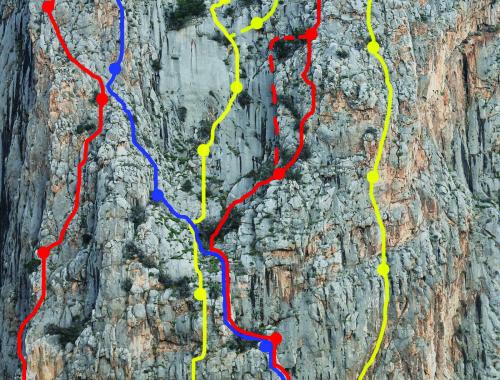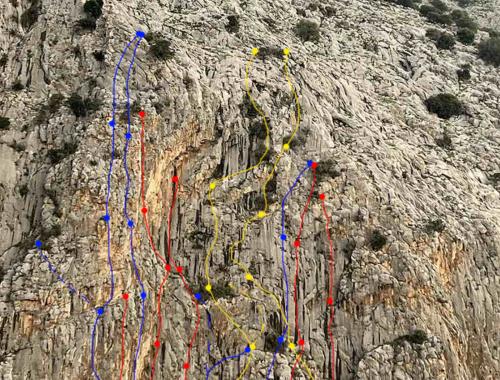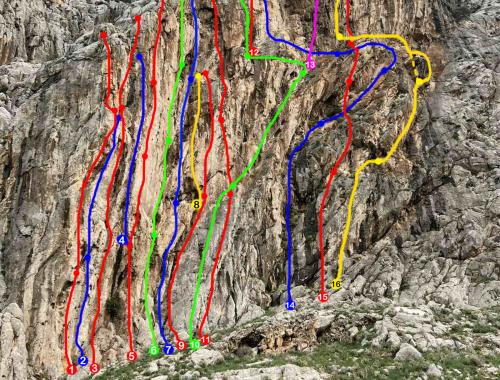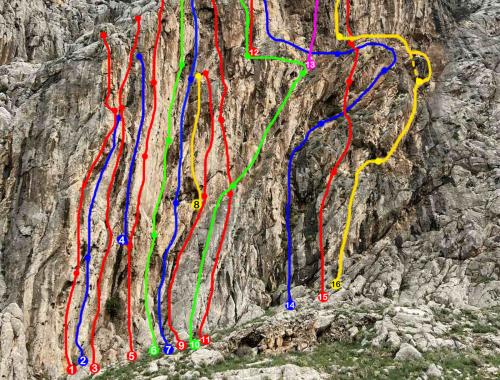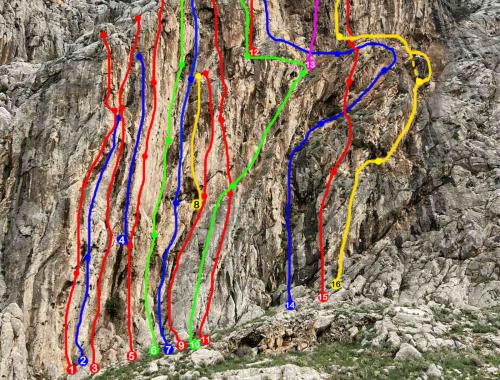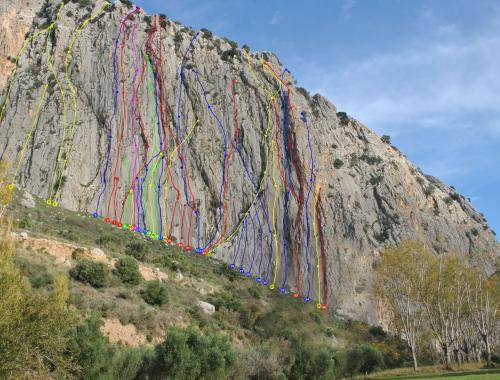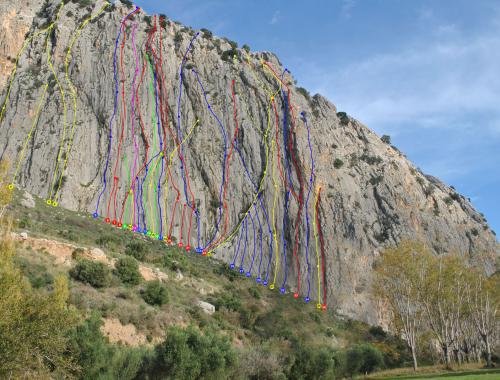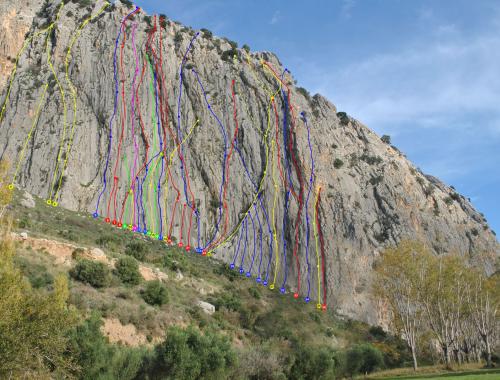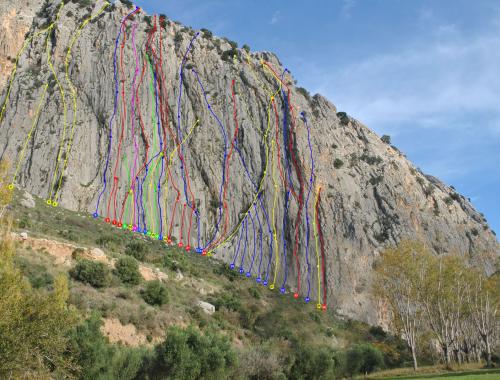
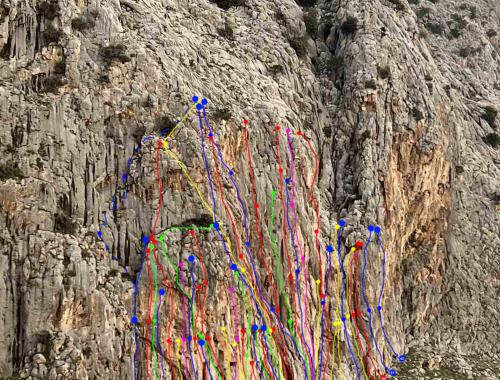
6b sport route (120 m, 3 pitches) — a harmonious line with elegant technical moves and stunning views.
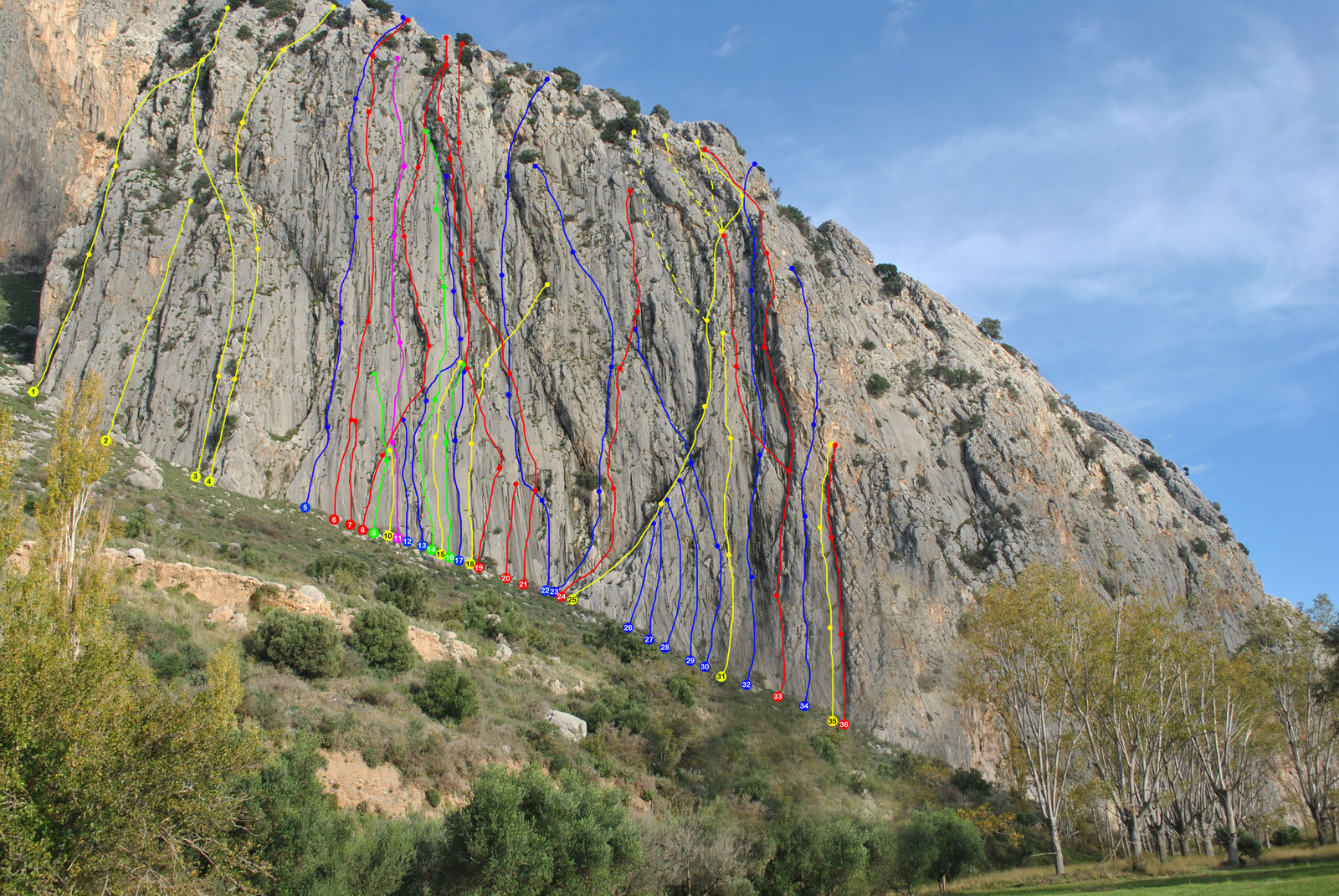
Impressive 240 m route with excellent rock, technical sections, and fully equipped belays.
Technical Details
Length (m)
240.00
Pitches
6
Bolts
32
Belays
6
Rings
1
Description
Impressive 240 m route with excellent rock, technical sections, and fully equipped belays.
“Ellinomania” (6b, 240 m) was completed and first climbed on 8/5/2005 by D. Aivazidis and D. Mavropoulos.
The line starts 2 m to the right of “Fissure Brown” and follows natural formations — mainly water grooves and cracks — up to the large ledge.
Pitch 1: Follows a dihedral with a wide crack formed between a small pillar and the main wall, then moves into a system of three water grooves, continues briefly, and makes a rightward traverse to the belay.
Pitch 2: Moves slightly right and upward into a small groove, then exits left onto a slab. It continues upward to a fixed cord in a hole; it’s best to make a belay here instead of the normal R2 to avoid rope drag. After the cord, an easy dihedral on the right leads to a ledge atop a small pillar. From there, a leftward traverse reaches the belay on a comfortable stance.
Pitch 3: Climbs water grooves to a belay located to the right, above a small step.
Pitch 4: Moves diagonally left, then straight up through a small dihedral — the crux of the route — and follows a crack with bolts to the next belay.
Pitch 5: Climbs straight up a few meters, then traverses right under a small overhang. It continues up a vertical wall with an exit to the right. Extreme caution is needed above the third bolt — large unstable rocks are present.
Pitch 6: Starts with a rightward traverse, climbs a dihedral, then follows a crack to a small roof, passes it, and enters a dihedral leading to the belay.
Pitch 7: Climbs straight up, passing a ledge at around 20 m, and continues vertically to the final belay.
The rock is excellent throughout the route, though the section from R4 to R5 contains visible rockfall hazards.
In particular:
Right of R4 lies a large detached block that could easily shift.
On pitch 5, above the 3rd bolt, there are loose rocks ready to fall if used as holds — the exit traverse must be done slightly lower.
R5 itself sits on a detached stone ledge that should not hold two people at once.
Required gear: A full set of nuts and 1–2 medium friends.
All belays are equipped with double rings (on 12 mm and 10 mm bolts), suitable for rappel descent or retreat.
Rappel descent with 60 m ropes is possible from R7, R6, R5, R3, R2, and R1 (6 rappels).
Alternative descents:
Via “African” or “Christoforos Agnoglou” using the last belay of “African” (under the tree on the left end of the ledge on pitch 7).
From R7, a short 20 m rappel leads there.
Alternatively, an easy 4 m rightward traverse from R7 leads to the big terrace and the marked path descending toward the “Tower” rappels or the climbers’ descent trail to the broken section.
The first repeat was done on 16/10/2005 by V. Zekis and E. Zekis.
“Ellinomania” (6b, 240 m) was completed and first climbed on 8/5/2005 by D. Aivazidis and D. Mavropoulos.
The line starts 2 m to the right of “Fissure Brown” and follows natural formations — mainly water grooves and cracks — up to the large ledge.
Pitch 1: Follows a dihedral with a wide crack formed between a small pillar and the main wall, then moves into a system of three water grooves, continues briefly, and makes a rightward traverse to the belay.
Pitch 2: Moves slightly right and upward into a small groove, then exits left onto a slab. It continues upward to a fixed cord in a hole; it’s best to make a belay here instead of the normal R2 to avoid rope drag. After the cord, an easy dihedral on the right leads to a ledge atop a small pillar. From there, a leftward traverse reaches the belay on a comfortable stance.
Pitch 3: Climbs water grooves to a belay located to the right, above a small step.
Pitch 4: Moves diagonally left, then straight up through a small dihedral — the crux of the route — and follows a crack with bolts to the next belay.
Pitch 5: Climbs straight up a few meters, then traverses right under a small overhang. It continues up a vertical wall with an exit to the right. Extreme caution is needed above the third bolt — large unstable rocks are present.
Pitch 6: Starts with a rightward traverse, climbs a dihedral, then follows a crack to a small roof, passes it, and enters a dihedral leading to the belay.
Pitch 7: Climbs straight up, passing a ledge at around 20 m, and continues vertically to the final belay.
The rock is excellent throughout the route, though the section from R4 to R5 contains visible rockfall hazards.
In particular:
Right of R4 lies a large detached block that could easily shift.
On pitch 5, above the 3rd bolt, there are loose rocks ready to fall if used as holds — the exit traverse must be done slightly lower.
R5 itself sits on a detached stone ledge that should not hold two people at once.
Required gear: A full set of nuts and 1–2 medium friends.
All belays are equipped with double rings (on 12 mm and 10 mm bolts), suitable for rappel descent or retreat.
Rappel descent with 60 m ropes is possible from R7, R6, R5, R3, R2, and R1 (6 rappels).
Alternative descents:
Via “African” or “Christoforos Agnoglou” using the last belay of “African” (under the tree on the left end of the ledge on pitch 7).
From R7, a short 20 m rappel leads there.
Alternatively, an easy 4 m rightward traverse from R7 leads to the big terrace and the marked path descending toward the “Tower” rappels or the climbers’ descent trail to the broken section.
The first repeat was done on 16/10/2005 by V. Zekis and E. Zekis.
Access
About 35–45 minutes approach from the base, starting 2 m right of “Fissure Brown” in the
Approach time: 45 minutes
Recommended Equipment
Full set of nuts
1–2 medium friends
Two 60 m ropes (for 6 rappels)
Helmet
1–2 medium friends
Two 60 m ropes (for 6 rappels)
Helmet