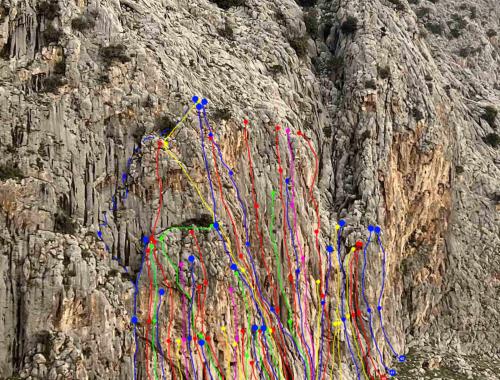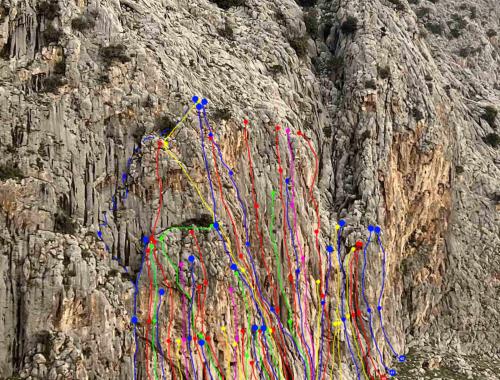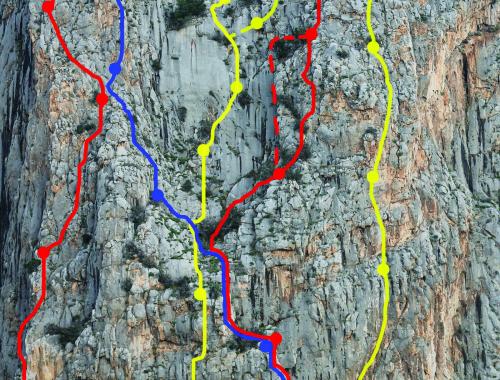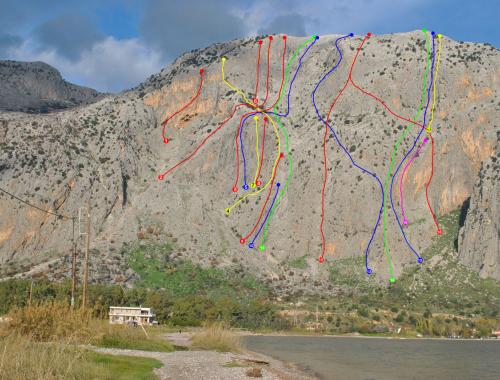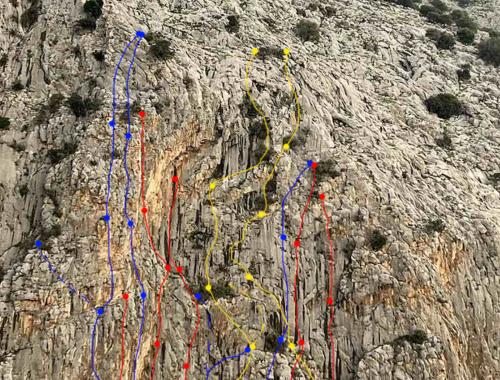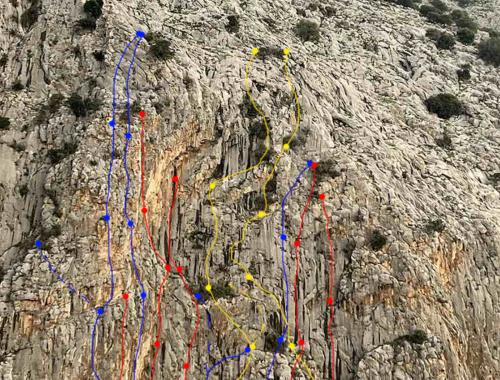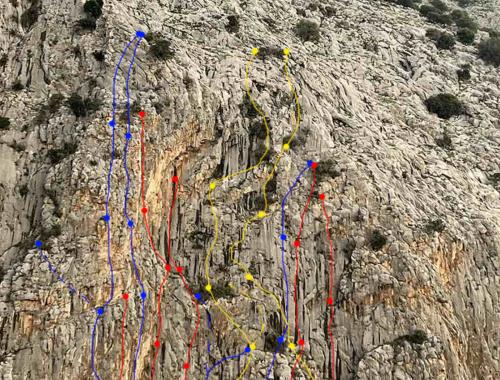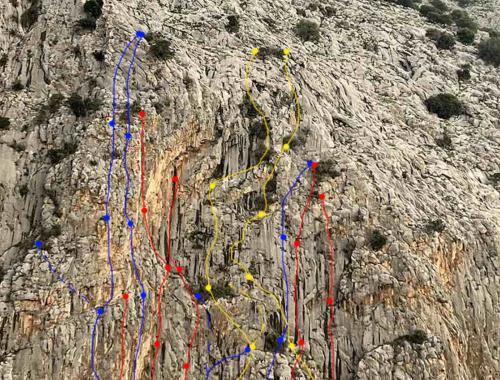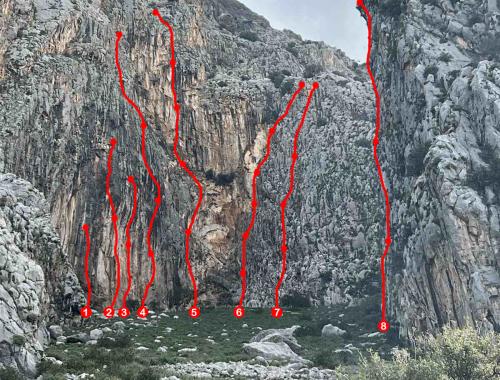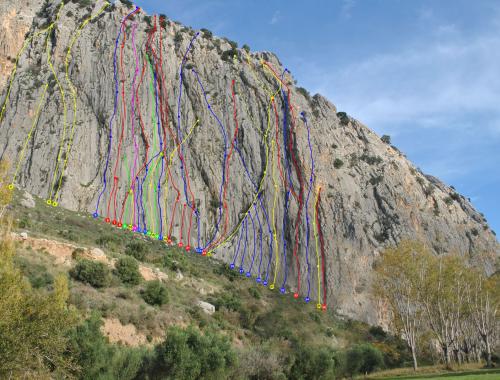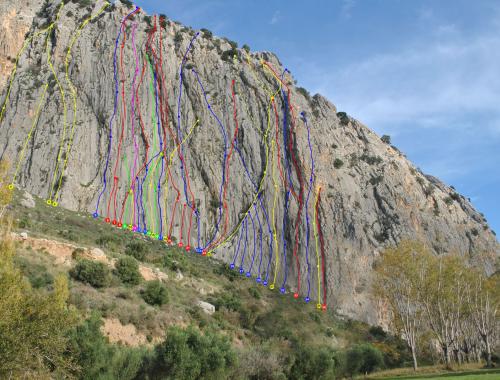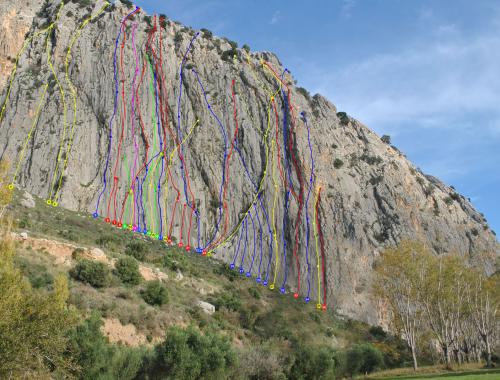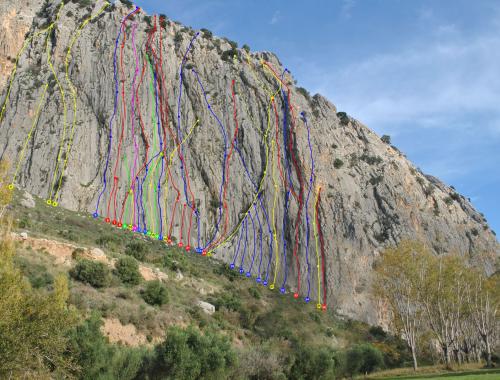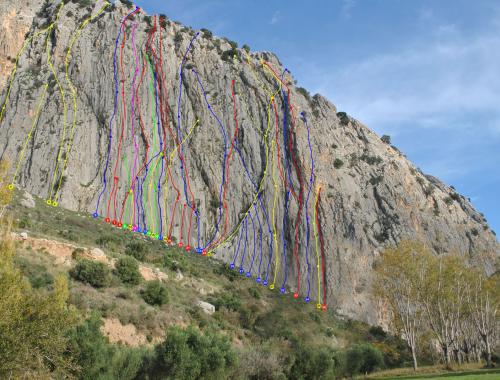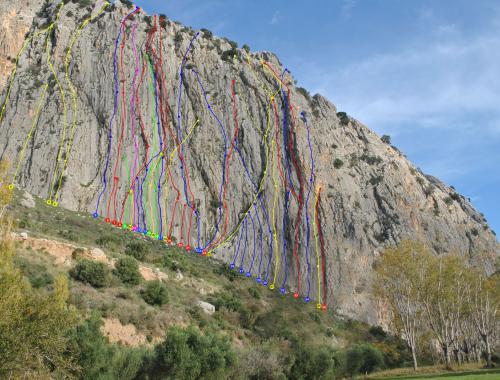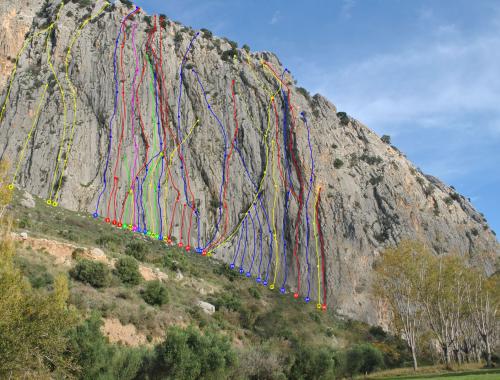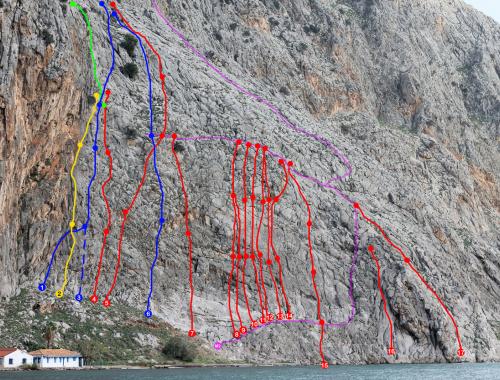
Voie sportive 6a (80 m, 2 longueurs) — dalle régulière, exposée et fluide sur un calcaire parfait.
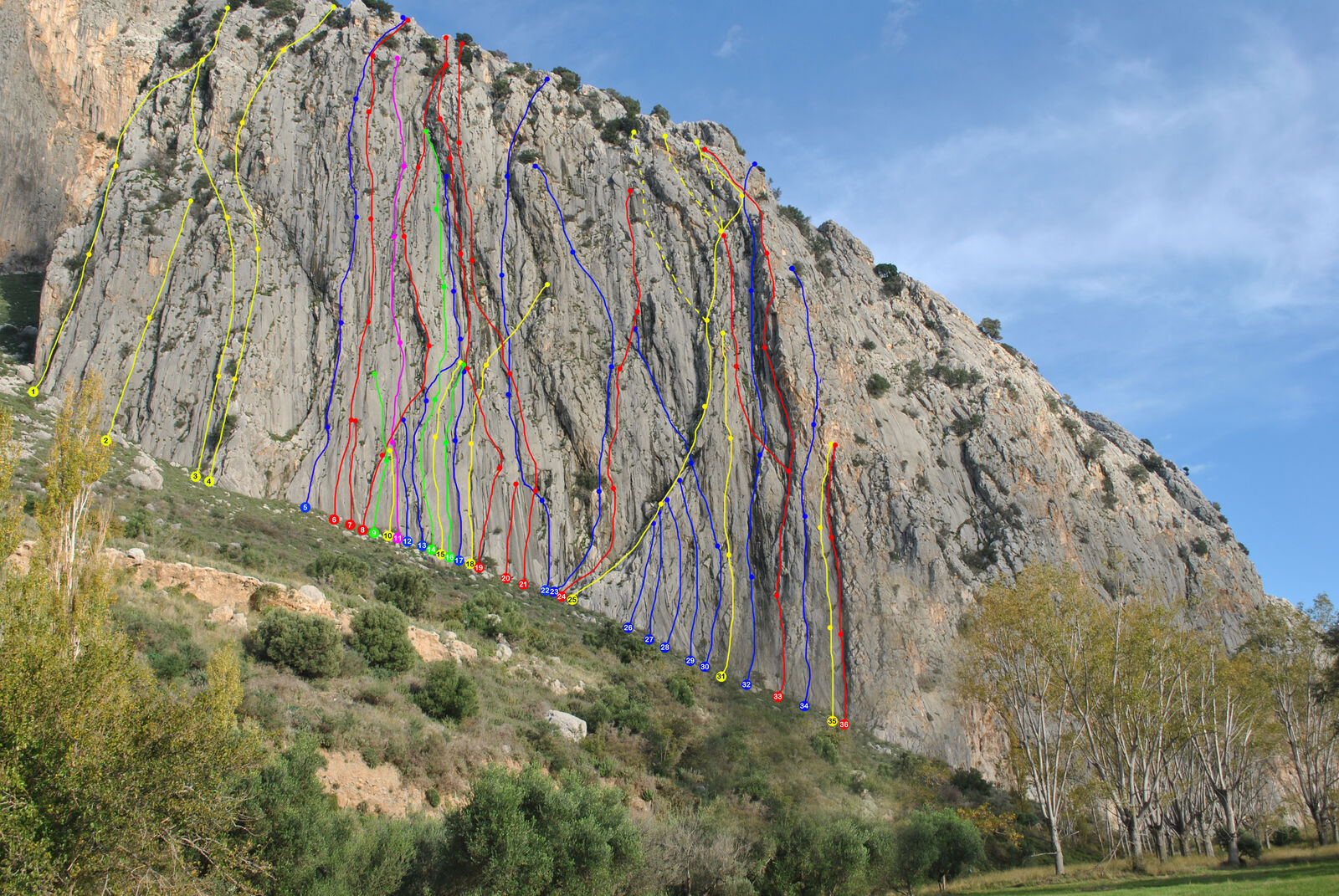
“Afrikana” (6a, 200 m) was first climbed on May 4, 1975, by D. Korres and John X., and since then has become one of the classic routes of Varasova.
The route is equipped with some intermediate fixed protection, while all belay stations are fitted with rings suitable for abseil descent.
For a repeat ascent, useful gear includes a set of nuts, a set of friends, and slings.
The rock quality is excellent.
The route is equipped with some intermediate fixed protection, while all belay stations are fitted with rings suitable for abseil descent.
For a repeat ascent, useful gear includes a set of nuts, a set of friends, and slings.
The rock quality is excellent.
Technical Details
Length (m)
200.00
Pitches
7
Bolts
19
Belays
5
Rings
1
Description
Pitch Description
Pitch 1 (30 m):
Begins up a water groove (IV), then follows an easy dihedral (IV+) trending up and right, leading to a ledge with belays also used by nearby routes.
Pitch 2 (40 m):
Start with a rightward traverse on a ledge, climb straight up for a few meters, then make a delicate rightward balance traverse (V+). Continue straight toward the dihedral; after overcoming the crux at its start (V+), follow it up to the belay.
Pitch 3 (30 m):
Begins with a move (VI) just above the belay, crossing the arête to the right and reaching a slab. Continue up a dihedral that takes good nuts and slings. A delicate leftward exit (V+) leads to the belay ledge.
Pitch 4 (25 m):
Start up and right, but immediately after the bolt (about 5 m above the belay), move left to the base of a water groove that gradually steepens (VI–) and leads to the next belay.
Pitch 5 (20 m):
Continue straight on a slab (V), then into an easier dihedral leading to the belay, which is shared with the route “Christoforos Agnoglou.”
Pitch 6 (30 m):
Climb up and slightly right over easy ground (IV) to reach a dihedral (V), which you follow to a distinctive tree. The belay is at the base of this tree.
Pitch 7 (25 m):
Climb behind the tree and up large broken rocks (IV+), then continue easily (IV) to a ledge left of another tree, where you’ll find the belay shared with “Ellinomania.”
Descent
Descent can be made by abseil using the anchors of Afrikana, or via those of Christoforos Agnoglou or Ellinomania.
Alternatively (though not recommended), a short rightward traverse (4 m) from R7 leads to the large ledge, from where red marks guide you right and down to the abseil stations of Pyrgos and Kalidonische.
Since the route faces west, even on hot summer days a fast team can complete it by starting early in the morning, before the wall comes into the sun around midday.
Pitch 1 (30 m):
Begins up a water groove (IV), then follows an easy dihedral (IV+) trending up and right, leading to a ledge with belays also used by nearby routes.
Pitch 2 (40 m):
Start with a rightward traverse on a ledge, climb straight up for a few meters, then make a delicate rightward balance traverse (V+). Continue straight toward the dihedral; after overcoming the crux at its start (V+), follow it up to the belay.
Pitch 3 (30 m):
Begins with a move (VI) just above the belay, crossing the arête to the right and reaching a slab. Continue up a dihedral that takes good nuts and slings. A delicate leftward exit (V+) leads to the belay ledge.
Pitch 4 (25 m):
Start up and right, but immediately after the bolt (about 5 m above the belay), move left to the base of a water groove that gradually steepens (VI–) and leads to the next belay.
Pitch 5 (20 m):
Continue straight on a slab (V), then into an easier dihedral leading to the belay, which is shared with the route “Christoforos Agnoglou.”
Pitch 6 (30 m):
Climb up and slightly right over easy ground (IV) to reach a dihedral (V), which you follow to a distinctive tree. The belay is at the base of this tree.
Pitch 7 (25 m):
Climb behind the tree and up large broken rocks (IV+), then continue easily (IV) to a ledge left of another tree, where you’ll find the belay shared with “Ellinomania.”
Descent
Descent can be made by abseil using the anchors of Afrikana, or via those of Christoforos Agnoglou or Ellinomania.
Alternatively (though not recommended), a short rightward traverse (4 m) from R7 leads to the large ledge, from where red marks guide you right and down to the abseil stations of Pyrgos and Kalidonische.
Since the route faces west, even on hot summer days a fast team can complete it by starting early in the morning, before the wall comes into the sun around midday.
Access
Follow the main trail to the African sector. The path is well-defined, mostly dirt and rock, with some steep parts.
Walking time: approximately 15–20 minutes from the base trailhead to the foot of the wall.
Walking time: approximately 15–20 minutes from the base trailhead to the foot of the wall.
Approach time: 20 minutes
Recommended Equipment
1 full set of nuts
1 full set of friends (cams)
Several slings (for natural protection and trees)
12–14 quickdraws
Double ropes, 60 m each
Helmet
1 full set of friends (cams)
Several slings (for natural protection and trees)
12–14 quickdraws
Double ropes, 60 m each
Helmet