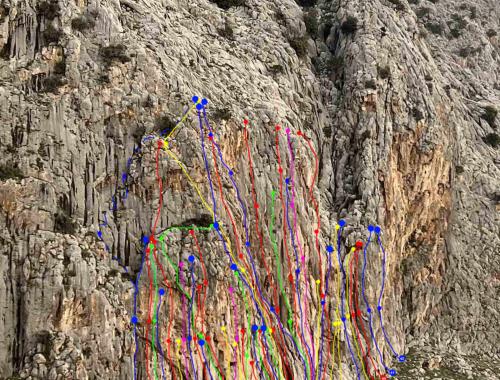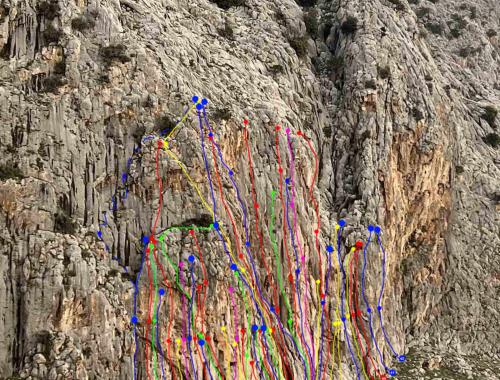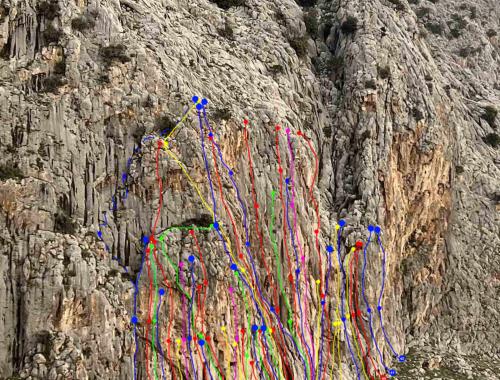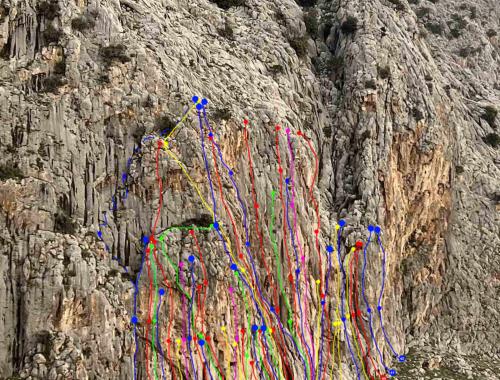
Voie sportive 6a+ (80 m, 2 longueurs) — élégante, technique et idéale pour progresser en dalle.
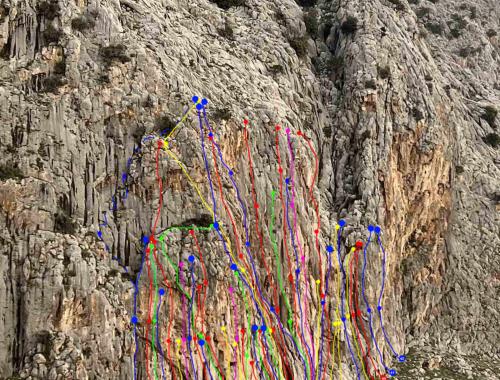
Serious 220 m route on Varasova, with beautiful dihedrals, few protections, and demanding gear placements.
Technical Details
Length (m)
220.00
Pitches
6
Bolts
5
Belays
6
Rings
1
Description
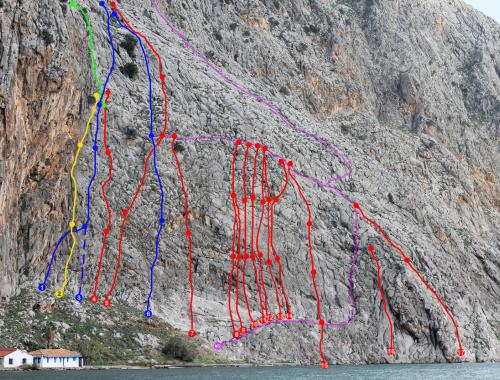
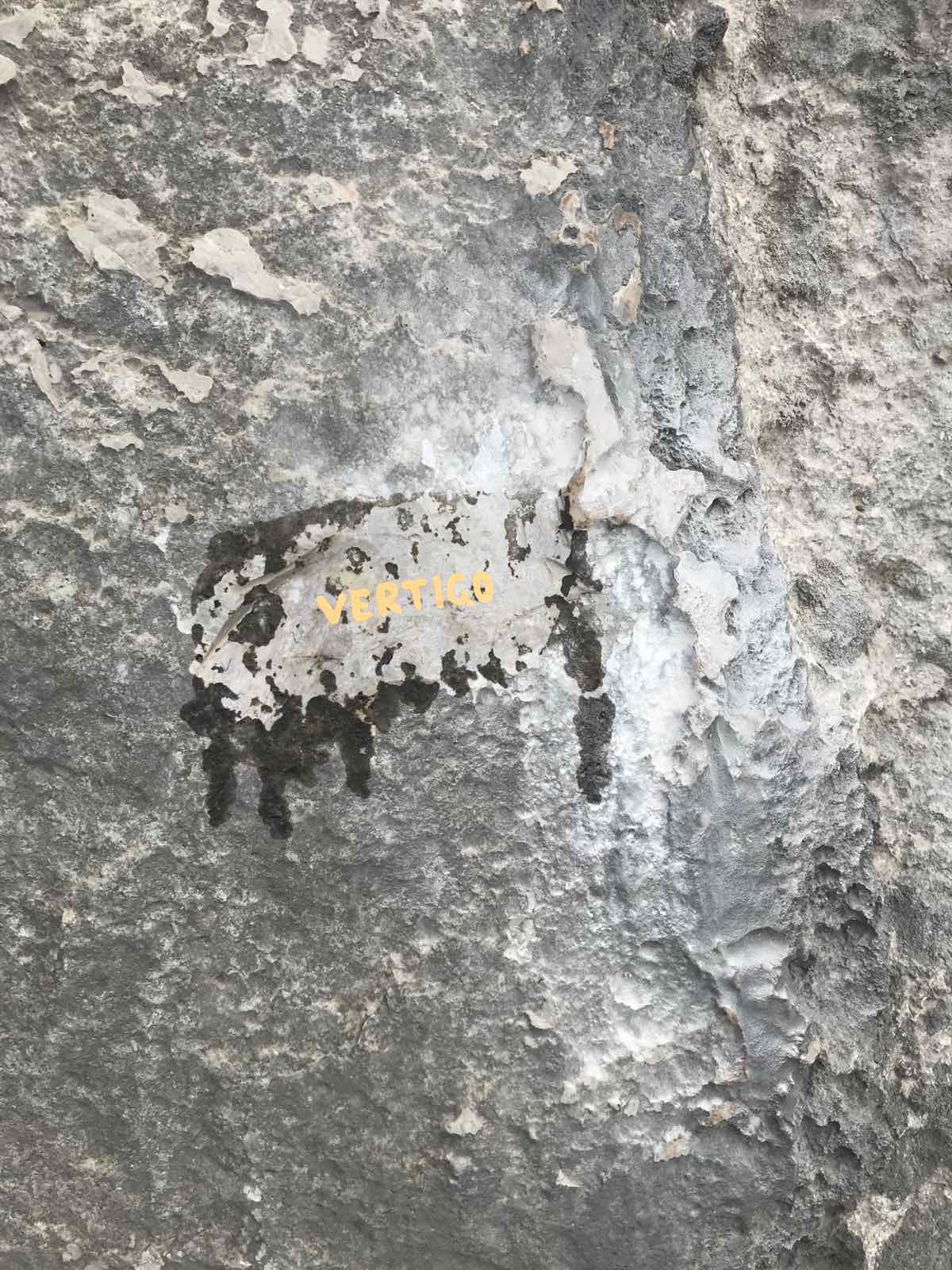
“Vertigo” (VI+, 220 m) was opened in 1984 by L. Giannakoulis and M. Malakou.
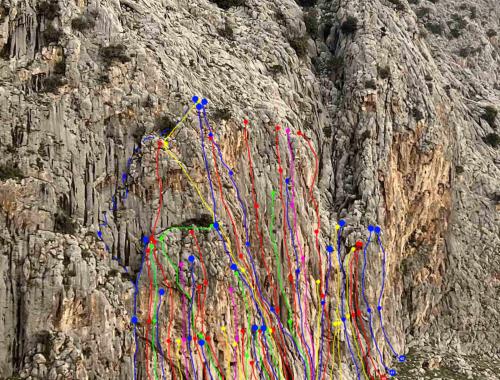
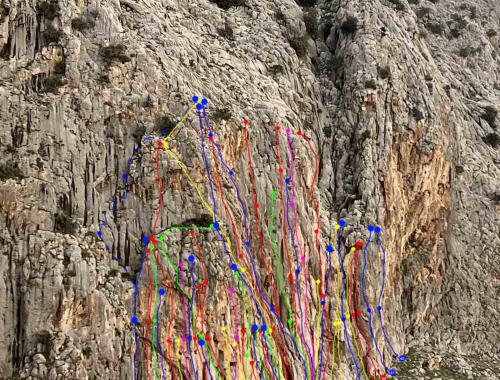
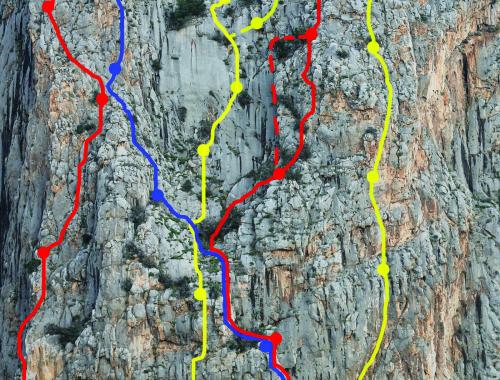
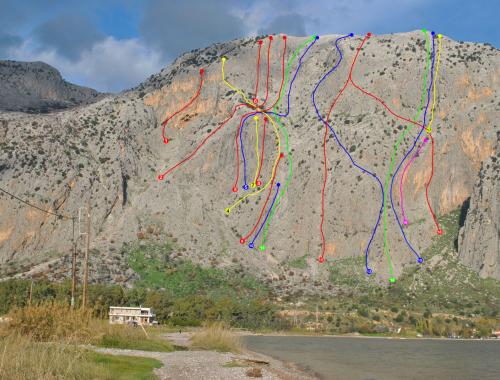
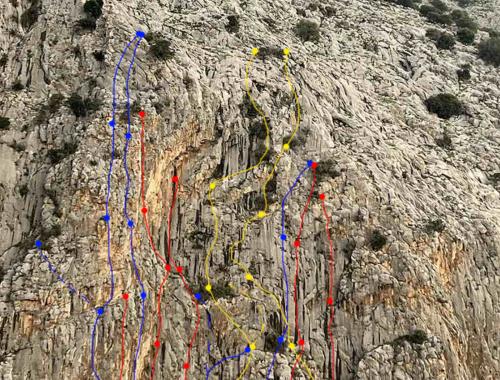
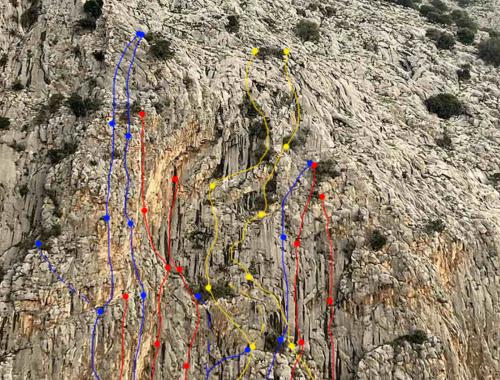
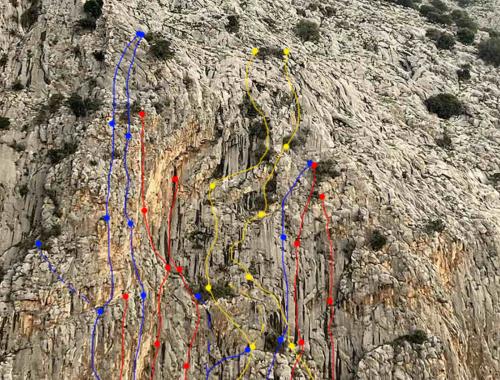
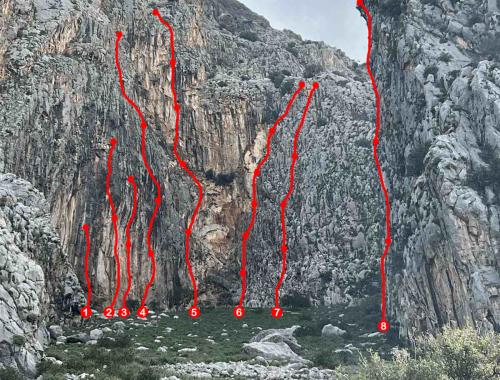
It is a serious adventure route located in the African sector, running to the right of “Ellinomania” and to the left of “Kali Kardia.”
The route offers enjoyable climbing on crack–dihedral systems and slabs, following a fairly clear natural line that can be protected.
Vegetation is an issue since the route has few repeats, which increases both the technical and protection difficulty.
There are virtually no fixed protections or belays, except for a few old pitons.
An exception is at R2, where a belay with rings was later added by an unknown route that intersects Vertigo.
Because of the lack of previous clear descriptions or fixed belays, this account and belay locations are based on a modern repeat and are subjective.
Pitch 1 (30 m): Climb a beautiful slab (V+) with good protection options. Belay on a ledge before a tree, where there is one piton. Be cautious of loose rock.
Pitch 2 (30 m): Start with an obvious leftward traverse to a sustained crack–dihedral (V+). At its end, move right to a ledge (the belay of the newer, unknown route).
Pitch 3 (25 m): Move right into easier terrain, then into a dihedral and slightly left to a slab (V+, 2 pitons). Belay hanging on an overhang with a cord in a large hole.
Pitch 4 (20 m): Move right through easy terrain with bushes (IV), taking care with loose rock. Belay in a small garden. (Pitches 3 and 4 may be linked to avoid the hanging belay.)
Pitch 5 (40 m): The crux pitch (VI+). Follows the characteristic crack, well-protected through the hardest moves. After the crux, protection becomes poor and belay options limited until the end of the crack, where a belay is made.
Pitch 6 (30 m): Continue straight and slightly left on a slab into a dihedral (1 piton). After passing trees on the left and a yellow wall, traverse right to a ledge and belay on an olive tree.
Pitch 7 (45 m): Go straight up through trees to a small dihedral on the right, then through more vegetation and another easy dihedral to a soil-filled gully. Belay on a large tree to the left.
Descent:
Return via the rappels of African, located 25 m up and left. On the ledge above the rappels, a large white “R” with an arrow marks the direction.
Note:
According to the old Varasova guide by G. Aligiannis (description by A. Bougiouklou, 29/4/1989), the VI+ of the 5th pitch can be avoided by a variation: from R3, instead of going right, continue straight up (IV) and then right (V). This variation could not be confirmed in this description.
It is a serious adventure route located in the African sector, running to the right of “Ellinomania” and to the left of “Kali Kardia.”
The route offers enjoyable climbing on crack–dihedral systems and slabs, following a fairly clear natural line that can be protected.
Vegetation is an issue since the route has few repeats, which increases both the technical and protection difficulty.
There are virtually no fixed protections or belays, except for a few old pitons.
An exception is at R2, where a belay with rings was later added by an unknown route that intersects Vertigo.
Because of the lack of previous clear descriptions or fixed belays, this account and belay locations are based on a modern repeat and are subjective.
Pitch 1 (30 m): Climb a beautiful slab (V+) with good protection options. Belay on a ledge before a tree, where there is one piton. Be cautious of loose rock.
Pitch 2 (30 m): Start with an obvious leftward traverse to a sustained crack–dihedral (V+). At its end, move right to a ledge (the belay of the newer, unknown route).
Pitch 3 (25 m): Move right into easier terrain, then into a dihedral and slightly left to a slab (V+, 2 pitons). Belay hanging on an overhang with a cord in a large hole.
Pitch 4 (20 m): Move right through easy terrain with bushes (IV), taking care with loose rock. Belay in a small garden. (Pitches 3 and 4 may be linked to avoid the hanging belay.)
Pitch 5 (40 m): The crux pitch (VI+). Follows the characteristic crack, well-protected through the hardest moves. After the crux, protection becomes poor and belay options limited until the end of the crack, where a belay is made.
Pitch 6 (30 m): Continue straight and slightly left on a slab into a dihedral (1 piton). After passing trees on the left and a yellow wall, traverse right to a ledge and belay on an olive tree.
Pitch 7 (45 m): Go straight up through trees to a small dihedral on the right, then through more vegetation and another easy dihedral to a soil-filled gully. Belay on a large tree to the left.
Descent:
Return via the rappels of African, located 25 m up and left. On the ledge above the rappels, a large white “R” with an arrow marks the direction.
Note:
According to the old Varasova guide by G. Aligiannis (description by A. Bougiouklou, 29/4/1989), the VI+ of the 5th pitch can be avoided by a variation: from R3, instead of going right, continue straight up (IV) and then right (V). This variation could not be confirmed in this description.
Access
Approach: About 35–45 minutes from the base, following the path leading to African and Ellinomania.
Important: “Vertigo” has few repeats and significant vegetation difficulty and risk are increased. Recommended only for experienced teams comfortable with placing natural protection.
Important: “Vertigo” has few repeats and significant vegetation difficulty and risk are increased. Recommended only for experienced teams comfortable with placing natural protection.
Approach time: 45 minutes
Recommended Equipment
Full set of nuts
Full set of friends (up to #3)
Many slings
Two 60 m ropes (for rappels via African)
Helmet
A few pitons/cords for reinforcing belays
Full set of friends (up to #3)
Many slings
Two 60 m ropes (for rappels via African)
Helmet
A few pitons/cords for reinforcing belays