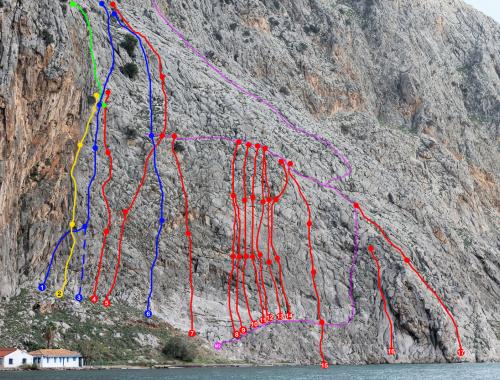
Grande voie traditionnelle 5a à Rubicon — douce, solide et chargée d’histoire.
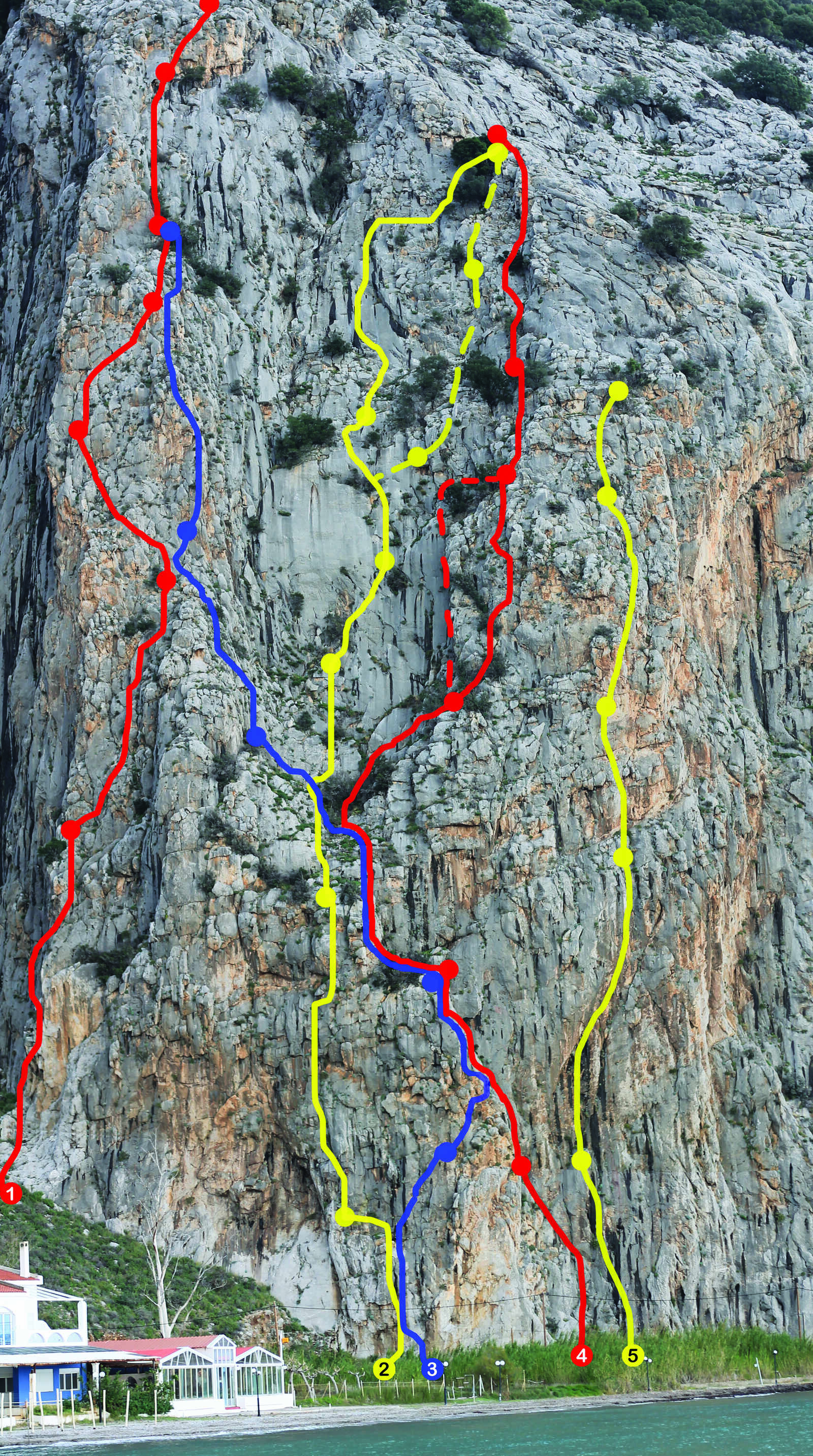
Classic traditional multi-pitch (220 m) at Vasilopoulos — low difficulty, beautiful dihedrals, and an ideal route for a pure trad experience.
Technical Details
Length (m)
220.00
Pitches
7
Bolts
0
Belays
7
Rings
0
Description
“Skoupa” was first opened in 1966 by P. Idosidis, Th. Zacharanis, and M. Kottaris.
The line follows the large pillar above the marsh with reeds and spring water, visible from below. Despite its moderate grade, the absence of fixed protection demands good route-finding skills and confident use of natural placements, making it a great challenge for climbers wishing to test themselves in traditional style climbing. The rock quality is solid throughout most of the route, with only a few loose sections. There are 3–4 old pitons scattered along the line.
The 1st pitch begins up a dihedral (IV+), then traverses right onto a ledge. This dihedral also serves as a variation of the neighboring route Zacharanis–Xynou Dihedral. From the ledge, continue down and right, then up a crack (V, 1 piton) to easier terrain. The belay is set on a comfortable inclined ledge — it’s best to split this pitch due to rope drag.
The 2nd pitch starts right of the large tree above the belay, climbing straight up (IV) on solid rock, though care is needed with some loose blocks. It trends up and right to a comfortable ledge, where the belay is made using an old piton and natural gear.
The 3rd pitch moves up, then left (III) to a dihedral (IV+), leading to a small stance suitable for a belay with small to medium nuts.
The 4th pitch moves slightly right (V-, 1 piton) and then up (IV) on strong, featured rock to a comfortable ledge for the belay.
The 5th pitch climbs toward a slightly overhanging band (V-), then easier ground up to a large ledge with trees, where the belay is made.
The 6th pitch follows the dihedral (IV-) above the trees, on sharp but solid limestone. The overhanging exit (V) leads to a ledge with a piton and natural thread for the belay.
The 7th and final pitch goes straight up a crack (V-), then continues over progressively easier ground to a large ledge, where the route ends.
The route exits onto the great terrace of the wall, from which descent is via the marked trail rightward, leading to the abseil stations of “Pyrgos” and “Kalidonische.”
The line follows the large pillar above the marsh with reeds and spring water, visible from below. Despite its moderate grade, the absence of fixed protection demands good route-finding skills and confident use of natural placements, making it a great challenge for climbers wishing to test themselves in traditional style climbing. The rock quality is solid throughout most of the route, with only a few loose sections. There are 3–4 old pitons scattered along the line.
The 1st pitch begins up a dihedral (IV+), then traverses right onto a ledge. This dihedral also serves as a variation of the neighboring route Zacharanis–Xynou Dihedral. From the ledge, continue down and right, then up a crack (V, 1 piton) to easier terrain. The belay is set on a comfortable inclined ledge — it’s best to split this pitch due to rope drag.
The 2nd pitch starts right of the large tree above the belay, climbing straight up (IV) on solid rock, though care is needed with some loose blocks. It trends up and right to a comfortable ledge, where the belay is made using an old piton and natural gear.
The 3rd pitch moves up, then left (III) to a dihedral (IV+), leading to a small stance suitable for a belay with small to medium nuts.
The 4th pitch moves slightly right (V-, 1 piton) and then up (IV) on strong, featured rock to a comfortable ledge for the belay.
The 5th pitch climbs toward a slightly overhanging band (V-), then easier ground up to a large ledge with trees, where the belay is made.
The 6th pitch follows the dihedral (IV-) above the trees, on sharp but solid limestone. The overhanging exit (V) leads to a ledge with a piton and natural thread for the belay.
The 7th and final pitch goes straight up a crack (V-), then continues over progressively easier ground to a large ledge, where the route ends.
The route exits onto the great terrace of the wall, from which descent is via the marked trail rightward, leading to the abseil stations of “Pyrgos” and “Kalidonische.”
Access
About 30–40 minutes from the base, on the large pillar above the marsh with reeds and stream springs.
Approach time: 40 minutes
Recommended Equipment
Full set of nuts
Full set of friends
Plenty of slings
Two 60 m ropes
Helmet
Full set of friends
Plenty of slings
Two 60 m ropes
Helmet